Suppose you’re carrying high-interest debt like credit cards, personal loans, or lines of credit. A home equity debt consolidation loan can be a practical way to regain control of your finances. This strategy allows homeowners to use the equity in their property to pay off multiple debts and replace them with one lower-interest loan and one monthly payment.
In this guide, you’ll learn how a debt consolidation home equity loan works, its benefits and risks, and how Mortgage Alliance can help you choose the right solution based on your financial situation.
What Is a Home Equity Debt Consolidation Loan?
A home equity debt consolidation loan is a loan secured against the home that allows you to pay off multiple high-interest debts using the equity you’ve built in your property.
Definition
It is a loan that uses your home as collateral so you can:
- Pay off credit cards
- Clear personal loans
- Eliminate high-interest lines of credit
- Combine all balances into one lower-interest loan
How It Works
- You borrow against your available home equity
- You use the funds to pay off your existing debts
- Those debts are replaced with one new monthly payment
Other Names You May Hear
- Debt consolidation home equity loan
- Consolidate debt with a home equity loan
- Home equity consolidation loan
All of these terms refer to the same idea: using home equity to replace expensive debt with a single, more affordable loan.
How Consolidating Debt with Home Equity Works
Here is a simple step-by-step overview of how homeowners typically consolidate debt using home equity.
Step-by-Step Overview
- List all outstanding debts and balances
- Calculate how much equity is available in your home
- Apply for a home equity loan, HELOC, or refinance
- Use the funds to pay off existing debts
- Make one new monthly payment going forward
Types of Home Equity Products Used for Debt Consolidation
Check out the types of home equity products:
A) Home Equity Loan
A home equity loan is a loan that lets you borrow money using the value you’ve built up in your home as security.
- You receive a lump-sum payout
- Fixed interest rate
- Fixed monthly payments
- Best for large, one-time debt consolidation
Best for:
Individuals seeking stable payments and a predictable repayment schedule.
B) Home Equity Line of Credit (HELOC)
A HELOC is a revolving credit product secured by your home.
Key features:
- Borrow as needed up to your credit limit
- Pay interest only on the amount you use
- Variable interest rates
- Flexible repayment options
You may be required to pay:
- Only interest
- Or both principal and interest
Best for:
Phased or flexible debt payoff, and people who want access to ongoing credit.
C) Mortgage Refinance (Cash-Out)
- Replace your existing mortgage with a larger one
- Roll your debts into the new mortgage balance
- Often, the lowest interest rate option
Best for:
Homeowners with strong equity and long-term repayment plans.
Benefits of Using Home Equity to Consolidate Debt
Using a consolidated debt home equity loan offers several advantages:
- Interest rates are lower than those of personal loans and credit cards
- One simple monthly payment
- Improved monthly cash flow
- Easier budgeting
- Potential credit score improvement
- Faster path to becoming debt-free
Risks and Considerations
There are important risks to understand before using your home equity.
- Your home is used as collateral
- Risk of foreclosure if payments aren’t made
- Longer repayment periods may increase total interest
- Set-up fees, such as appraisal and legal costs
- Variable interest rates on HELOCs
- Temptation to build new credit card debt
This strategy works best when paired with a clear repayment plan and disciplined spending habits.
Who Should Consider a Home Equity Debt Consolidation Loan?
This option may be suitable if you:
- Own a home with sufficient equity
- Carry high-interest credit card or loan debt
- Have a stable income
- Struggle with monthly cash flow
- Are committed to disciplined repayment
- Want to simplify multiple payments into one
Home Equity Loan vs Other Debt Consolidation Options
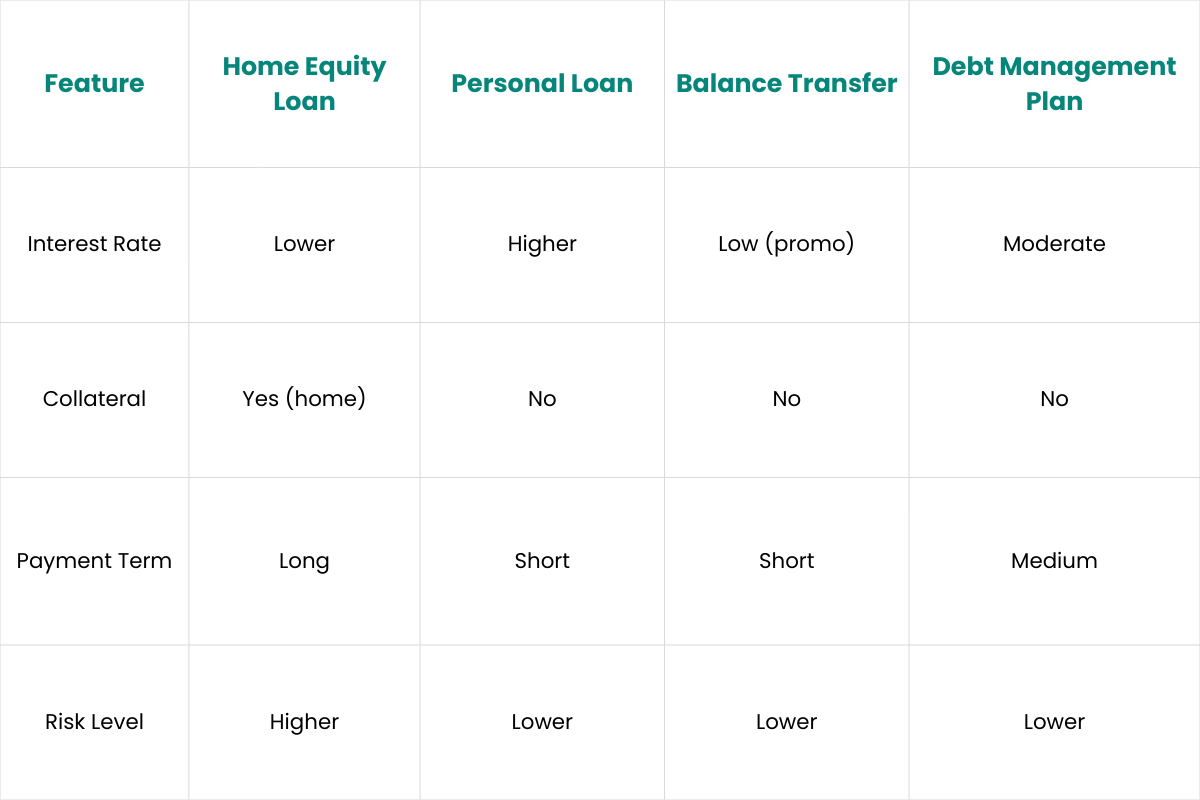
Costs and Interest Rates
Interest Rates
- Home equity loans: fixed or variable
- HELOCs: usually variable, based on prime
- Refinances: lowest rates overall
Typical Fees
- Home appraisal
- Legal and registration fees
- Title search
- Administration fees
- Discharge fees
Understanding HELOC Rules in Canada
- You may borrow up to 65% of your home’s value on a HELOC
- Combined mortgage and HELOC cannot exceed 80% LTV
- Minimum equity required:
- 20% for mortgage-linked HELOC
- 35% for standalone HELOC
- Stress test applies at higher qualifying rates
- Variable interest rates tied to the lender’s prime rate
How Mortgage Alliance Can Help
Mortgage Alliance is a national mortgage brokerage network that connects borrowers with multiple lenders across Canada.
How They Assist with Debt Consolidation
- Review your debts and home equity
- Compare home equity loans, HELOC, and refinance options
- Find competitive interest rates
- Structure a personalized debt-consolidation strategy
Benefits of Working With a Broker
- Access to more lenders
- Transparent advice
- Better chance of approval
- One application, multiple offers
How to Qualify for a Home Equity Debt Consolidation Loan
Lenders usually look at:
- Available home equity
- Credit score
- Income stability
- Debt-to-income ratio
- Property value and appraisal
- Existing mortgage balance
Tips for Successful Debt Consolidation
- Close or limit old credit accounts
- Avoid new debt
- Pay more than the minimum
- Build an emergency fund
- Stick to your repayment plan
- Review your progress regularly
Step-by-Step Application Process
- List all current debts
- Estimate your home equity
- Speak with a mortgage broker or lender
- Choose the best consolidation option
- Submit documents and the application
- Pay off debts and begin your new repayment plan
A home equity debt consolidation loan can be a powerful tool for Canadian homeowners who want to replace high-interest debt with one affordable payment. While it offers lower interest rates and simpler payments, it also comes with risks because your home is used as collateral.
Before moving forward, it’s essential to carefully review your options and consult with a qualified mortgage professional.
Mortgage Alliance advisors can help you compare home equity loans, HELOCs, and refinancing options to build a debt-consolidation strategy that fits your goals and financial situation.
Frequently Asked Questions
Is it smart to consolidate debt with a home equity loan?
It can be if you have a stable income, sufficient equity, and a repayment plan.
How much equity do I need to consolidate debt?
Most lenders require at least 20-35% equity, depending on the product.
Will this hurt my credit score?
Short-term inquiries may occur, but long-term improvement is common.
Can I use a HELOC instead of a home equity loan?
Yes, especially for phased or flexible debt repayment.
What happens if I can’t make payments?
Your lender may take possession of your home if you default.